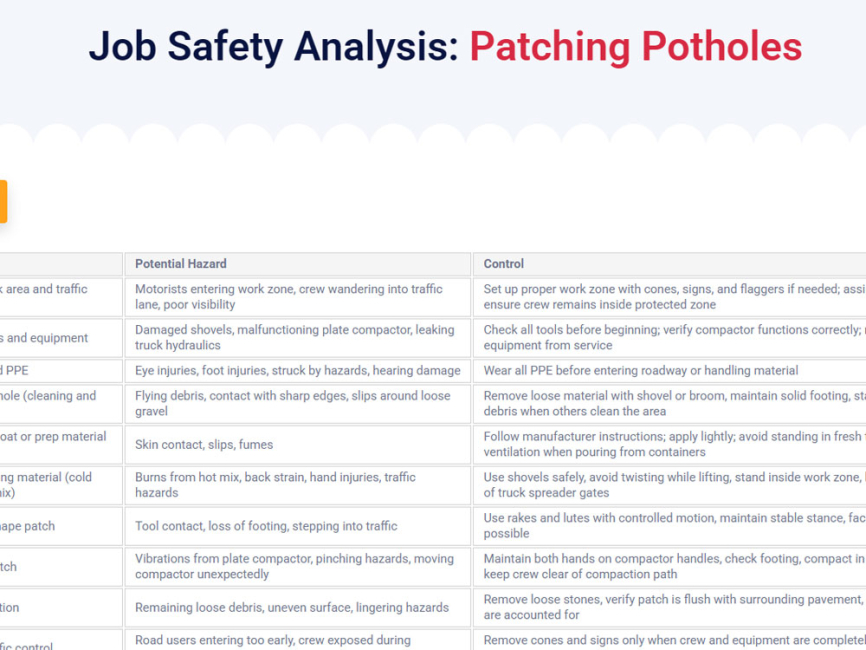
Putting together a Job Safety Analysis binder from scratch sounds like one of those projects you tackle with good intentions, right up until you are three coffees deep, surrounded by half-finished documents, and seriously questioning your life choices. Every task needs its own JSA, every JSA needs to be clear, accurate, and actually usable in the field, and before long you are buried in paperwork instead of out solving real problems. The truth is, most highway departments do not struggle because they do not care about safety, they struggle because building a complete, consistent JSA library takes a ton of time.
A solid JSA binder is not just a box to check, it is a practical tool your crew can rely on. It should cover your most common operations, things like flagging, ditching, culvert work, equipment operation, tree removal, and working in traffic. Each JSA should break the job down into steps, identify hazards, and outline control measures in plain language that makes sense to the people actually doing the work. If it reads like a legal document, it is probably going to sit on a shelf collecting dust next to that one wrench nobody admits losing.
The challenge is getting there. Writing JSAs from scratch requires not only time, but also a strong understanding of both the work and the risks involved. Then comes the formatting, consistency, and the inevitable revisions when you realize three documents describe the same task in three completely different ways. Before long, what started as a safety initiative starts to feel like a full-time writing assignment.
This is where tools like Public Works Safety Center come in and make life a whole lot easier. Instead of reinventing the wheel, or in this case the entire fleet, you can access a library of ready-to-use JSAs that cover the tasks your crew is already performing every day. These are built specifically for public works operations, not generic office environments or industries that have never seen a snowplow.
One of the biggest advantages is speed. You can find the JSA you need, print it, and have it in your binder in minutes. No staring at a blank screen, no debating whether you forgot a hazard, and no trying to standardize formatting across dozens of documents. It is about as close as you can get to a “plug and play” safety program without actually hiring someone to follow you around with a clipboard.
Even better, the JSAs are completely unbranded. That means when you print them out, they look like your documents. Clean, professional, and ready to go, without any logos or watermarks. Your crew does not need to know whether you spent three hours writing it or three minutes printing it, they just need clear guidance to do the job safely. And let’s be honest, if you can save time and still end up looking organized and prepared, that is a win in anyone’s book.
Building your JSA binder then becomes less about writing and more about curating. You can focus on selecting the right documents, organizing them in a way that makes sense for your operations, and making sure they are actually used in the field. That is where the real value is, not in who typed the words, but in whether the information helps prevent injuries and keeps your crew thinking ahead.
At the end of the day, a well-built JSA binder should work for you, not the other way around. If you can shortcut the most time-consuming part of the process by using a resource like Public Works Safety Center, you free yourself up to focus on what really matters, leading your team, improving operations, and making sure everyone goes home in one piece. And if it also makes you look like the most organized supervisor in the county, well, that is just an added bonus.

 Every road department has far too many roads and way too little money. The challenge isn't deciding whether roads need to be repaved, it's dec…
 Putting together a Job Safety Analysis binder from scratch sounds like one of those projects you tackle with good intentions, right up until you are t…
 If you have ever stood at the front of a room full of highway or public works crew members with a PowerPoint clicker in your hand, you already know th…
 If you have spent any time in public works, you already know that job titles can be about as consistent as spring potholes, meaning not very. One town…
 Rainy Days Are Safety Days: Why Every Highway Superintendent Should Keep a Training Binder Handy As every highway superintendent knows, no two days in…
 A survival guide for highway supers with frayed nerves and a half-empty coffee mug. The Anatomy of a Board-Induced Migraine Town boards are like aspha…